
So sorry to hear of your loss, Richard!

What is Levamisole Hydrochloride?
Levamisole Hydrochloride (Levamisole HCl), is an anthelmintic (anti-worm) agent commonly used in large livestock such as
cattle, pigs and sheep. In 1971 it was found to have immunostimulatory
properties and investigation into its use in humans began to expand. Currently, Levamisole
HCl is used in humans for diseases related to imbalances in the regulation of
immune responses or deficiencies of the immune system, including autoimmune
diseases, chronic and recurrent diseases, chronic infections and cancer. It has
beneficial effects on host defense mechanisms and restores depressed immune
responses in animals and humans. Another interesting use of levamisole in humans is as a treatment for common warts (verruca vulgaris).
News of its anthelmintic efficacy and immune system benefits has been known among aquatic hobbyists for years. The problem, however, is that there is not much in the way of definitive information on its use and application in the hobby. Anecdotal accounts of how it has worked for those ‘outside the box’ aquarists who first braved its use with fish, and accounts of personal experience with Levamisole in individual aquariums are helpful, but the ‘your mileage may vary’ factor is immense. Word about its usefulness in treating internal parasites in the ornamental fish trade has spread, but information regarding its use is limited and sometimes conflicting. From the information I have found thus far, Levamisole HCl is safe to use in aquaria and effective against many internal parasites, especially nematodes, when used in appropriate dosages. It does not harm the bio-filter, plants, invertebrates or uninfected fish. As an added benefit, it boosts the immune competence of fish, humans, large animals, birds and some reptiles.
This article hopes to pull
together what scientific information is
available, a bunch of individual accounts, apply some common sense, and put together in one place a helpful guide
to the use of Levamisole HCl for treating aquarium fish.
Why would anyone use a cattle/pig/sheep de-wormer in a fish tank?
Do you want to know why?
Internal parasites that can be treated effectively by Levamisole HCl are endemic. They are everywhere. Fish are also susceptible to these parasites. Since the parasites are what we are attempting to eliminate from our fish, we need a medication that is designed to affect those parasites.
Does the medication need to be labeled for 'fish only' use? Not if you know what the medication is composed of, whether it contains any chemicals or additives that would be harmful to fish, if it will work in water, how it works, and what the possible side effects may be. Many medicines that are used in 'fish only' preparations are also used in humans and animals.
Medications like:
Neomycin
Kanamycin
Erythromycin
Magnesium Sulfate
-- to name only a few
AND...Levamisole Hydrochloride
In fact, manufacturers of fish specific medications are beginning to package their products in loose powdered or liquid form. Want to see why? See THIS page from the Aquascience Research Group which also contains a helpful table on aquarium drug dosages.
The single most important factor once you've decided that a non fish specific medication is safe to use in aquaria is determining the correct dosage. We'll look into that factor later. For now, let's look at its chemical composition and how it works.
Levamisole Hydrochloride Chemical Composition
Molecular Formula: C11H12N2S•HCl
To see a beautiful, animated 3D model (warning--long download!) of the molecule, or get information on other chemicals, visit ChemExper.comMolecular Weight: 240.75062
Mass of C11H12N2S: 204.28968
Mass of HCl: 36.46094
Specific gravity: .69724
Levamisole Hydrochloride is the LEVO-rotatory form (left-handed) of tetramisol. The DEXTRO isomer (right-handed) contributes to the toxicity, but not the therapeutic effect so it has been removed in marketed preparations.
Levamisole HCl
is light sensitive. Store product in tightly closed, light resistant containers. Leave off tank lights or UV lighting when treating.
There is also a phosphate form of Levamisole.
How does Levamisole HCl work?
How does Levamisole HCl work as an antiparasitic agent?
Levamisole HCl is absorbed through the gut, can also be absorbed through the skin and is distributed throughout the body. It affects the
neurotransmitters within the parasite and paralyzes the worm (spastic paralysis). The fish then passes the inactive worms. Good gravel vacuuming is advised after treatment to remove the paralyzed worms. It is not ovicidal, which
means it will not affect eggs already present, but it will affect the larval
stage of the worm. To ensure complete eradication of the parasite treat again after remaining eggs have hatched.
How does Levamisole HCl work as an immunomodulator?
The mechanism of action for its immunostimulating effects is not well understood. It is believed that it restores cell-mediated immune function in peripheral T-lymphocytes and stimulates phagocytosis by monocytes. The drug appears to restore depressed immune function rather than to stimulate response to above-normal levels. There are multitudes of medical studies being done with its use in humans and animals, the goal being to attain understanding of its immunomodulating mechanism. The mechanism will be defined, with time. However, at the time of the writing of this article, there is no complete answer to this question. For us, it is enough to know that it does stimulate immune function in fish that are suffering due to parasites or disease.
What if I overdose my fish?
The LD-50 (the lethal dose of a compound for 50% of animals exposed) of Levamisole HCl is 250 mg/l per 24 hours. This level of dosage is
much higher than that which is prescribed for use in a freshwater bath, which is the method used in our fish tanks (See "Recommended Dosage" below). Be aware, however, that overdosing with this medication could result in
death to your fish. There have been accounts of adverse side effects in aquaria noted using higher than currently accepted appropriate dosing.
How long will it stay in my fish and how do I get it out of my tank?
Levamisole HCl is rapidly absorbed into the digestive system. Less than 6% of the medication is excreted unchanged in the urine and feces. Half-lives for several species have been recorded:
Cattle: 4 - 6 hours
Swine: 3.5 - 6.8 hours
Dogs: 1.8 - 4 hours
Absorption is systemic within 3 - 4 hours. Within three days 70%
of the medication will be gone from the fish via its excretory system. The vast majority of the compound will have been metabolized by your fish. The remainder can be removed by water changes and/or adding activated charcoal to your filtration system.
De-bunking a common misunderstanding about Levamisole HCl.
Does Levamisole HCl require a pH of below 7.0 to be effective?
In a word, NO.
This common misconception regarding the uselessness of Levamisole HCl in higher pH water needed a definitive answer.
Let's apply some common sense. When we look around at
the other uses of Levamisole HCl we find that one common formulation is administered by adding it to livestock drinking
water. Are all water supplies the same? It seemed unlikely to me that
among all the farms using this medication every water supply would
have a pH below 7.0.
After some digging around all over the Internet and phone calls to
various Veterinarians and chemical companies the answer I was given by Dr. Hal Sinclair of IVX Animal Health was
both clear and simple. Levamisole base (C11H12N2S)
is unstable in water and will degrade rapidly as pH levels increase. Levamisole HCl will not.
It's the addition of the hydrochloride molecule that makes the
difference.
Levamisole HCl is stable in water for up to 90 days and will do its job in aquaria with with both low and high pH values.
Taking the space to go through all this chemistry may be more than you
want to know. However, chemistry plays a large role in fishkeeping. It helps to be somewhat comfortable with the basics to
comprehend the Nitrogen cycle and to balance the aquatic environments
in which our fish live. Planted tank gurus, especially, spend time understanding the chemistry of
their tanks for both fish and plant benefit.
Chemistry has already helped us to answer the pH question which has been plaguing the community for years. We will need it again in order to determine effective dosing of Levamisole HCl to cure our fish. Knowing the chemical formula, the molecular weight, and the specific gravity of the molecule will give us the information we need to make some calculations that will help us to do just that.
Which parasites will respond to treatment with Levamisole HCL?
Levamisole HCl has been found highly effective in the treatment of mature and developing immature stages of
major stomach and bowel worm species in cattle and sheep including gastro-intestinal worms such as:
Stomach worms--Haemonchus
spp; Ostertagia spp; Trichostrongylus spp;
Roundworms--
Nematodirus spp (which include threadworms); Cooperia spp;
Nodular worms--Oesophagostomum;
Chabertia spp;
Hookworms--Bunostomum spp; Necator
spp; and Ancylostoma spp; and
Lungworms-- Dictyocaulus spp.
Nematodes (roundworms) in particular are a common problem. Nematodes such as Capillaria, Eustronggylides, Camallanus, and Contracaecum are common among many fish species. Levamisole HCl is highly effective as a treatment against nematode species.
For excellent information on parasites of freshwater fish see the very informative articles posted at the University of Florida IFAS Extension: Introduction to Freshwater Fish Parasites
Cestodes (tapeworms)
For Cestodes the recommended treatment is Praziquantel.Trematodes (flatworms or flukes)
For Monogenean Trematodes with a direct life cycle the suggested treatment is Formalin, administered as a short-term or prolonged bath.
For Digenean Trematodes which have a complex life cycle, using differing hosts, the best control is to break the life cycle of the parasite. Elimination of the first intermediate host, the freshwater snail, is often recommended.
How can I tell which parasite is affecting my fish?
The best way to determine if your fish is suffering from parasites, and which kind they are, is to have the fish examined by a fish health specialist (veterinarian). Accurate diagnosis of an internal parasite infestation in aquatic animals is often outside of the ability of the average hobbyist. Stool samples, slides, microscopes and sometimes necroscopy, or in the worst case scenario, autopsy, are the most effective way to determine exactly what parasite is inside your fish. Many of us are just not equipped or knowledgeable enough to perform the necessary diagnostic procedures. What we can do is observe our fish, become aware of what symptoms may indicate parasitic infection, and learn what methods are best used to treat them.
Levamisole HCl is not a cure-all but it is a good first line of defense against many parasites common to wild caught fish.
Nematode infections in fish will present with one or more of the following externally observable symptoms:
To learn more about Nematodes read the article by Dr. Roy Yanong, Nematode (Roundworm) Infections in Fish.
- Hemorrhaging (bloody streaks in fins or body)
- White/translucent stringy feces
- Inflammation
- External lumps or nodules
- Necrosis (dead or dying tissue)
- Cysts
- Granulomas (which are a reaction by immune cells trying to wall off some foreign body, such as a worm)
They can look like little brown rocks in the shape of the worm but will have a distinct clear edge.
- Wasting
- Bloated abdomen with fish exhibiting otherwise normal behavior
- A bulge in the lower abdomen near the vent, or worms protruding from the anus (specifically Camallanus)
A little bit about parasites in general and nematodes in particular.
Healthy fish can carry a low load of parasites without ever showing outwardly visible signs. Fish that are stressed or sick are immune compromised and will find it difficult to keep down parasitic infections. Fish carrying a heavy parasite load also become more susceptible to secondary bacterial infections. Because parasites are everywhere, wild caught fish can be assumed to be harboring parasites whether they appear healthy or not. Quarantine tank treatment with Levamisole HCl prior to placing new wild caught fish into an established community tank is advised. This will both eliminate parasites (those affected by Levamisole HCl) and boost the immune system of your fish helping them to keep at bay any secondary infections as a result of parasitic damage.
The severity of damage caused by parasitic infection depends on a number of factors. The number of worms present in the fish, age, species of the fish and the sites of infection all affect the level of damage caused by the parasite. Most adult nematodes are found in the digestive tract although adult and other life stages of worms can be found in muscle tissue, organs, and tissues surrounding the organs. Levamisole HCl works primarily in the digestive tract so parasites located in organs or tissues may be unaffected by treatment.
Camallanus worms, specifically, can be very difficult to diagnose until you actually see worms protruding from the anus of the fish. By this time, the parasite load is so high that treatment can cause serious problems for the fish. The fish will have to pass a load of paralyzed worms before they can recover. If your fish is not eating, it is unlikely to be able to push the worms through its system. Try feeding live foods to tempt them to eat, or better yet, treat as soon as you see some of the other signs of possible worm infestation.
Nematodes have two major categories of life stages, direct and indirect.
As indirect hosts fish can be either the final host excreting eggs that begin the life cycle all over again, or the intermediate host as shown below:
Indirect Life Cycle with fish as intermediate host
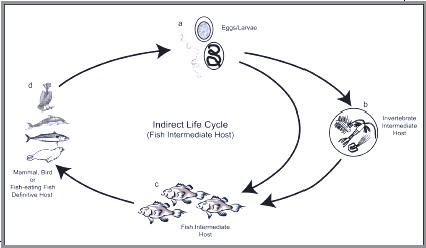 | In this case the fish is infected with the parasite, then eaten by another fish, bird, or mammal where the parasites will develop into reproductive adults. |
Credit: Tropical Aquaculture Laboratory; University of Florida
Indirect Life Cycle with fish as final host
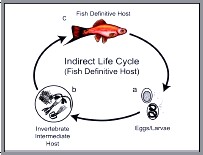 | The nematode eggs/larvae enter an intermediate host before being eaten by fish which are the final host. The eggs develop into reproductive adults within the fish. Some intermediate hosts are snails, Tubifex worms, or insect larvae. |
Credit: Tropical Aquaculture Laboratory; University of Florida
Direct Life Cycle
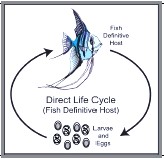 | Nematodes with a direct life cycle do not need an intermediate host. One fish can spread the infection directly to another by eating either eggs or larvae. |
Credit: Tropical Aquaculture Laboratory; University of Florida
Because Levamisole HCl is not harmful to the bio-filter, fish, plants, or invertebrates, you can safely treat the within the community tank. In fact, it is best to do so to eliminate possible parasites in any intermediate hosts that may be in the tank. Whenever adding any chemicals to your tank be sure set time aside after the initial dose to observe your fish. If you notice adverse effects such as rapid breathing, spasms, erratic behavior or sudden lethargy in the inhabitants take action to remove the medication.
Fish that are suffering from secondary bacterial infections due to parasitic worm damage should be removed to a quarantine tank for appropriate antibiotic treatment.
How do I use Levamisole Hydrochloride?
Before using whatever form of Levamisole HCl you acquire it is wise to read the Material Safety Data Sheet (MSDS) which describes prudent precautions regarding its use. The MSDS linked here is one from ScienceLab.com. If you are using a different product, Google the product manufacturer name+product name+MSDS to find the one specific to your medication. Most will be very similar depending on the formulation you are using.
Some resistance to Levamisole HCl action has been noted in farm animals. Be sure to complete the full course of treatment to avoid development of resistant strains in fish. Because it is light sensitive, store any unused medication in opaque containers.
Remove any carbon used in your filtration as it will absorb the
chemical. Turn off tank lights and UV lighting.
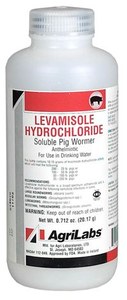
Levamisole HCl is available in several formulations. Below are a few manufacturer packaging examples. There are many.
Soluble Powder:
Bolus: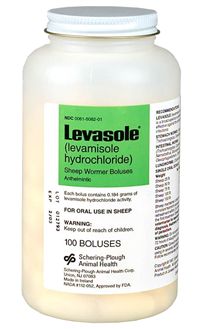
Injectable Levamisole phosphate 13.5% is equivalent to 136.5 mg of Levamisole Hydrochloride. Dosing is as follows: Levamisole (13.65% injectable) - 2 ppm (1.1 ml per 20 gallons).
This is the formulation I use in my tanks.
I find it easiest to use and most convenient
to store in the small dosages needed for
aquarium treatments. Divide the powder
into the amount you need for treatment.
Pack the unused portions in baggies in single
or multiple dose sizes, noting on each bag the
tank size it's intended to treat. Keep
at room temperature (with directions for use)
until needed. Shelf life for the powder is one or
two years, depending on which manufacturer you consult.
Store unused liquid solution in opaque containers for up to 90 days in the refrigerator.
Examples of the bolus variety and the injectable are on the right.
The bolus form is messy. It requires crushing the pill, determining the amount of powder needed, dissolving in tank water, filtering through a coffee filter, then adding the liquid to the tank.
The only injectable form of levamisole I have been able to locate is the phosphate form. If you locate a Levamisole HCl injectable, please comment here with the link to the supplier. Store below 70F (21C) and avoid freezing. The label says to use it 'as soon as possible after the original seal is broken.' This would lead me to believe that the shelf life is not very long.
There are other forms out there, such as Levamisole HCl drench, oral solutions, oral feed mixes, topical solutions and gel formulas. Check the formulation composition for additional medicines, additives or agents before using in your fish tank. Some forms are unsuitable for use with fish due to other ingredients. Ergamisol, the most commonly prescribed Levamisole formulation for human use, also contains colloidal silicon dioxide, hydrogenated vegetable oil, hydroxypropyl methylcellulose, lactose, mycrocrystalline cellulose, polyethylene glycol 6000, polysorbate 80, and talc.
I find the powdered soluble formula the most cost effective and best for storage, dosing and use.
What form you may choose will be dependent upon your location and availability. In the UK, for instance, Levamisole HCl is only available through a veterinarian. Check with your local regulations before ordering from suppliers outside your country.
Where Can I Get Levamisole HCl?
Levamisole HCl is sold under various names by different companies. Be sure to carefully investigate the product to insure its safety for use in aquatic animals.
Levasole
soluble pig wormer, mix with waterProhibit
powdered drench, mix with waterTramisol
sheep bolus--USRipercol
soluble powder for sheep--AustraliaLevam-30
'Ripercol Vet" or "Levaject Vet" in Denmark
oral powder--IndiaLevacide
UK injectableAvitrol Plus
liquid bird worming syrup (also contains Praziquantel), add to food, or directly to tank
There are many others. This is only a representative listing. To locate other products, please take advantage of Google or Yahoo search engines online.
Recommended Dosage
Dr. Roy Yanong, V.M.D. recommends the following for treating fish with internal parasites susceptible to Levamisole HCl:
"In answer to your question, the dosage rate for levamisole in a bath is 2 mg/L (2 ppm) for 24 hours (followed by 70-100% water change, and siphon the bottoms of the tanks), with repeat treatments necessary--retreat in 2-3 weeks, and probably one more time after that. This is regardless of size of fish."
The 2 mg/L dosage rate (of the active ingredient Levamisole) is currently (2007) the level being used by the scientific community. It effectively paralyzes Levamisole susceptible parasites at that concentration. Increasing the dosage level does not seem to have any greater effect. (Another good reason to avoid overdosing.) Paralysis of the worms takes place when that level of Levamisole is present in the host--your fish. Dr. Yanong recommends, whenever possible, trying to diagnose what parasite your fish are harboring prior to treatment. Work with an 'exotic pet' veterinarian, or a fish health specialist to insure you are treating with the right medication.
Dosage Calculation
Some helpful conversions:
For 100% Levamisole HCl in powdered form (Levasole, Soluble Pig wormer):
1 teaspoon = 4 grams
.5 teaspoon = 2 grams
.25 teaspoon = 1 gram
1.0 US Gallon = 3.78 Liters
Here is where our chemistry comes in.
The molecular formula for Levamisole base is C11H12N2SThe molecular formula for Levamisole HCl is C11H12N2S•HCl
Because we know the formula we can figure out the Grams/mole off the periodic table which is:
~204.32g/mole (rounded to hundreds) for levamisole.
~240.78g/mole for Levamisole HCl because of the HCl (hydrochloride) attachment.
The active anthelmintic ingredient is the Levamisole, not the Hydrochloride, so to attain a 2ppm concentration of Levamisole using Levamisole HCl we will need more Levamisole HCl because of the size (weight) of the molecule. For example, if we know we need 50mg (at 2mg/L this will treat a 25L sized tank, or about 6 gallons) of Levamisole base but we are using Levamisole HCl, to achieve the same concentration of the Levamisole base we need to make some conversions which works like this:
For those of us with underdeveloped math skills (like me), chefkeith has come to the rescue. He has created a Dosage Calculator for powdered Levamisole HCl.
To calculate how much Levamisole HCl powder you need simply type in the size of your tank in either liters or gallons and the measurement in teaspoons will be provided.
If you have a large volume of water to treat use the stock solution calculator which works like this:
Decide the size of the container you wish to use to create enough solution to treat all your tanks. Fill with dechlorinated water. Enter the size of the container in ml into the "amount of stock solution" field.
Now you enter the dosage size you want. If you want 1/2 cup of this solution to treat 20 gallons of water, then enter 4oz in the "dosage size", then 20 gallons in the "amount of water to treat".
The calculator then spits out that you need .64 teaspoons of Levamisole HCl to be added to that 2 liter bottle.
You can adjust the Levamisole ppm however you want it, but the default setting is at 2ppm.
He also includes a helpful link at the bottom for locating Levamisole HCl powder.
50mg=.05g
then divide that by 204.32 (weight in grams of Levamisole)
to get moles which is 2.447.
Then because its 1:1 (1 mole
levamisole each (basically)) you take
2.447 multiplied by 240.78 (so you get correct weight for added HCl)
and you get .0589g which is ~59mg.
Thus, 59 mg of Levamisole HCl is equivalent to 50 mg of levamisole base.
So:
2ppm = 2 mg/L Levamisole base
which converts to:
2.36 mg/L Levamisole HCl or
~9 mg/Gallon or 90 mg/10 gallons
How do you know how many milligrams of Levamisole HCl you need? More calculating:
We need 2.36 mg/L (or 9 mg/Gallon) of Levamisole HCl to treat our tank at the recommended dosage.
If we measure our tanks in Liters:
2.36 x (the size of your tank in liters) = mg/L of Levamisole HCl to treat your tank.
If we measure our tanks in gallons:
10 US gallons = ~38 Liters
For a 10g tank that means:
2.36 x 38 = 89.68 mg or ~90mg of Levamisole HCl will treat 10 gallons with a 2 ppm concentration.
Going by chefkeith's calculator a very small amount of levamisole powder is needed to treat a 10g tank (.076 grams, or .019 teaspoons). Now I don't know about you, but I don't own measuring devices that will enable me to accurately measure that tiny amount. Overdosing Levamisole HCl (even massively so!) has been common practice for a long time. However, adding more does not increase its effectiveness and can have negative effects up to and including death. Try to avoid it, if at all possible. The 2ppm dosage level will do the job.
Lacking the necessary tools, I generally eyeball my powder measurements into usable sizes. Since a quarter teaspoon is about 1 gram and we need roughly one tenth of that amount for a 10g qtank treatment I do the following:
- Measure a level 1/4 teaspoon onto a smooth surface.
- Take a razor blade and divide that quarter teaspoon into 10 even piles. Each tiny pile is one treatment for 10 gallons.
- Store each tiny pile in tiny plastic baggies (or tin foil) with a '10g' label in an opaque container.
Not very scientific, I know. But it does get me close, and I am confident enough in the safety of the medication that I have no fear for my fish that a slight overdose will be dangerous. In fact, prior to this article, I had previously treated fish with Levamisole concentrations as high as 800 mg/10 gallons and saw no negative effects. That has not been the outcome in all cases (See "Comments" below). Overdosing is not recommended. Increasing the dosage level has no effect on the efficacy of the drug, and can be dangerous.
*For those who cannot access Levamisole HCl, Charles Harrison Ph.D. has a very helpful article on Flubendazole.
Flubendazole is an effective medication for Camallanus and other nematode infections and is adsorbed, rather than ingested. It is a good medication for treating fish who are no longer eating. It is available on order from his website: http://inkmkr.com/Fish/#anchor1234.
It will kill snails, so if you have a thriving snail population consider removing your fish to a quarantine tank (without snails) before using Flubendazole. A large dead and decaying snail population will seriously foul your tank environment.
Summary
Levamisole HCl is a safe and effective anthelmintic for use in aquariums when administered in the proper dosage. It does not harm the biofilter, plants or invertebrates (including shrimp) in your tank and has the added benefit of stimulating the immune system of immunocompromised tank inhabitants. I highly recommend its inclusion in any fishkeeper's arsenal of medications. For those of us who purchase wild-caught fish, it should be part of our prophylactic quarantine tank treatments for newly purchased fish.
Hobbyists have been using it for years now, and there are few reports of negative effects on fish. At higher dosages than recommended there have been some reports of cloudy water at initial treatment, and a very few reports of rapid respiration or stress related behavior in fish. I've also located a few accounts of massive overdosing leading to wipeouts in tank populations. One reported result of treatment stated yellow water, clamped fins and heavy breathing in cichlids, as well as explosive plant growth. After a couple of days, the negative effects on the cichlids seemed to disappear so he continued the treatment regime. I suspect the phosphate form may have been the formulation used in this case, but was not able to determine that definitively as I could not locate the drug he cited to find the information.
Dosing levels prior to this information were all over the charts. Almost without exception, the dosages used were higher. Some were much higher. Recommendations ranged from 1-2 mg/l up to as much as 21 mg/l. Based on the research for this article it's my hope that hobbyists will face less confusion regarding the use of Levamisole HCl in aquaria.
Below is the treatment protocol I have used for treating parasites with Levamisole HCl. It is very similar to the treatment recommended by Dr. Yanong. Your mileage may vary.
- Determine the appropriate dosage for your tank.
- Treat with the lights off and increased aeration.
- Perform a largish water change prior to treatment. With my water supply I cannot do more than 50% without causing a tank crash so I don't do the 70-100% changes recommended.
- Treat once for 24 hours.
- Do a largish water change and vacuum to remove any paralyzed worms in the substrate.
- Return tank to normal lighting/feeding/cleaning cycle.
- Treat again in 5-7 days after a water change. If you know the
parasite you are treating and its life cycle adjust the timing for the
second treatment accordingly.
- Do another water change with gravel vacuum.
- Return to normal schedule.
- Treat a third time 1 - 2 weeks after your second treatment.
- Do another good vacuuming with water change and consider your treatment complete.
Usually, I see a marked improvement in vitality and appetite after the first treatment. Don't let this convince you that the fish is cured! Complete a full course of treatment. In commercial fish enterprises and in livestock there have been reports of various parasites developing resistance to Levamisole HCl treatment. If you see no improvement after the first treatment your fish may be suffering from a secondary bacterial infection caused by parasitic damage. Consider treating the affected fish in a quarantine tank with a good broad spectrum antibiotic such as Maracyn I and II, or Kanamycin.
Acknowledgments
I'd like to offer my thanks to many on the Loaches On Line forums for their input during the search for information on this article.
Special thanks go to sully, chefkeith, Desi, LES.., andyroo, and especially Dr. Gabriella Kadar, DDS (Dr. Momfish) who first introduced the use of Levamisole on the Loach Forum (and elsewhere) back in the late 1990's.
To MilitantPotato and jones57742 from PlecoFanatics:
Thank you, thank you, thank you! Without your mathematical and chemical expertise I could not have finished this article.
Sources
See the Bibliography.
This is not arranged in any particular order, but does contain the primary sources I accessed during the writing process. My apologies for the lack of standardized formating.
Disclaimer:
The information contained in this article is accurate to the best of my knowledge. Some of the information is based on hobbyist experience. I accept no responsibility for adverse effects of treatment by individuals following the advice given in this article. Please do your own investigating prior to using medications to ensure that you will not harm your fish.
Document Actions
